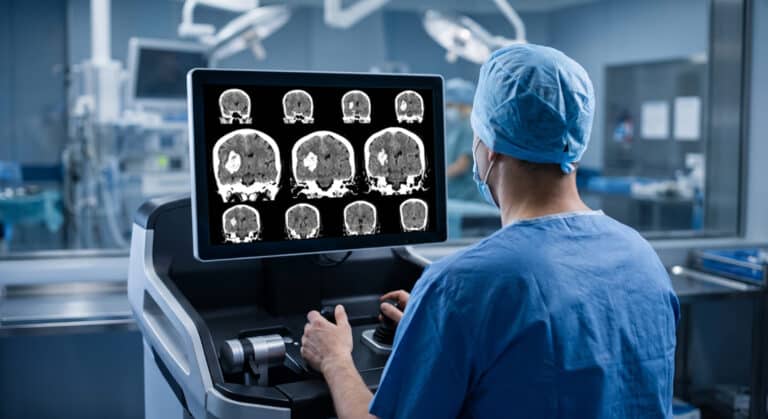
Illustrative image
Illustrative image (Credit: May Chanikran / Adobe Stock)
A neurosurgeon in Panama has successfully removed a blood clot from the brain of a stroke patient while operating a robotic system from more than 200 kilometres away. The procedure demonstrates how telerobotic technology could eventually help bring specialist stroke treatment to patients who are geographically distant from appropriately skilled clinicians.
The procedure involved a male patient in his late 60s who presented with symptoms of an acute stroke. Imaging confirmed a large vessel occlusion in the left middle cerebral artery. The patient was transferred to The Panama Clinic in Panama City, while neurosurgeon Dr Vitor Mendes Pereira operated from Santiago, in Panama’s Veraguas province.
Using XCath’s Iris robotic system, Pereira remotely navigated catheters through the patient’s blood vessels to the clot. The system provided live imaging that allowed him to guide the procedure from the remote console. A stent retriever, balloon occlusion and aspiration were used to remove the obstruction, with XCath reporting that the clot was removed on the first pass. The procedure was completed without noticeable communication delay or disruption to the surgical workflow.
A clinical team remained with the patient in Panama City throughout the procedure. Local neurosurgeon Dr Anastasio Ameijeiras Sibauste and robotic technologist Nicole Cancelliere assisted on site, and the local team completed the procedure at the patient’s bedside. The patient subsequently made a full recovery.
Addressing the Geography of Stroke Treatment
Mechanical thrombectomy removes a clot from a blood vessel in the brain to restore blood flow following certain types of ischemic stroke. The effectiveness of treatment is highly time-dependent, yet access to the specialist expertise and facilities required to perform thrombectomy remains limited.
XCath estimates that fewer than 3% of people globally have access to mechanical thrombectomy. The potential value of remote robotic intervention is therefore not simply that a procedure can be performed from a distance, but that specialist expertise could potentially be made available without requiring the specialist and patient to be in the same location.
The Panama procedure followed several earlier steps in the development of the technology. Pereira previously performed simulated remote thrombectomy using an XCath system in South Korea while operating from Abu Dhabi in 2024. He also used the system in Panama for interventions involving patients with brain aneurysms before undertaking the remote stroke procedure.
XCath plans further remote thrombectomy procedures, including trials in which Pereira will operate from Toronto while patients are hundreds or thousands of kilometres away. The company also aims to establish permanent trial sites in locations where access to thrombectomy is limited.
The Iris system is not yet commercially cleared in any country. It is, however, part of the US Food and Drug Administration’s Breakthrough Devices Program. XCath expects that, if approved, the system would initially be used predominantly for procedures where the clinician is physically present, while remote applications continue to develop.
Systems Engineering Perspective
Remote robotic surgery illustrates a fundamental systems engineering principle: the success of a capability solution depends on much more than the performance of its most visible technology.
The Iris robot is one element of a wider system involving the remote surgeon, the clinical team beside the patient, imaging equipment, robotic hardware, catheters and other instruments, communications infrastructure, software, operating procedures and the healthcare facilities at both locations. The Panama procedure reportedly involved collaboration among more than 60 physicians across five hospitals, highlighting the organizational as well as technical dimensions of the capability.
From a systems engineering perspective, interactions across interfaces between these elements become particularly important. Information and control commands must move between the surgeon and robotic equipment with sufficiently low latency, while live imaging must provide the information needed for safe decision-making. At the same time, responsibility demarcations between the remote specialist and local clinical team must remain clear throughout the procedure.
Verification and validation are also central. Demonstrating that individual components function correctly is not sufficient. The integrated system must be shown to perform as required, and the overall capability must ultimately satisfy the clinical need under realistic operating conditions. The progression from remote simulations to clinical procedures provides an example of increasingly representative evidence being developed as the technology matures.
The achievement therefore extends way beyond just remotely controlling a surgical robot. It demonstrates the integration of people, technology, communications, procedures and clinical expertise into a coordinated system capable of delivering highly specialised treatment across geographic distance. That whole-system perspective will remain important as telerobotic medicine progresses from individual demonstrations towards broader clinical use.
References
Bardsley, Daniel 2026, ‘Remote work: Panama surgeon removes brain blood clot from patient 200 kilometres away’, The National, 29 September 2026, <https://www.thenationalnews.com/news/uae/2026/09/11/remote-work-panama-surgeon-removes-brain-clot-from-patient-200-kilometres-away/>
Hale, Conor 2026, ‘XCath completes remote-controlled robotic stroke procedure’, Fierce Biotech, 29 September 2026, https://www.fiercebiotech.com/medtech/xcath-completes-remote-controlled-robotic-stroke-procedure>