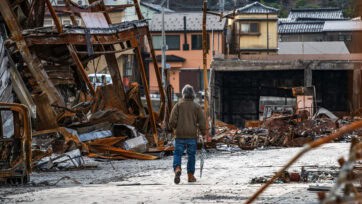
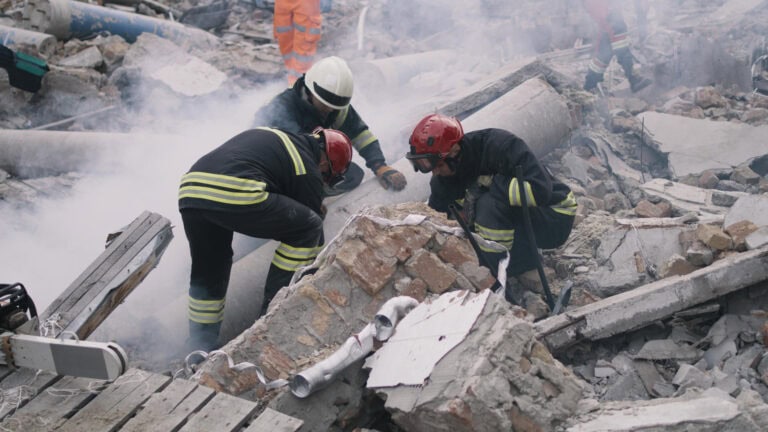
Illustrative image (Credit: Framestock / Adobe Stock)
On 10 October 2025, two powerful earthquakes struck offshore near Manay, Davao Oriental Province in the southern Philippines, a magnitude 7.4 (first) event followed hours later by a 6.8 tremor. The quakes triggered tsunami warnings, forced mass evacuations of coastal communities, damaged buildings, cut power and communications, and left multiple people dead and many more injured as rescue and damage-assessment efforts got underway.
Human toll and initial reports
Local and international news agencies reported at least seven fatalities and scores of injuries in towns across Davao Oriental and neighboring provinces; authorities also recorded substantial structural damage to schools, hospitals and homes. Panic spread as residents fled to higher ground after tsunami alerts were issued and then later lifted for most areas. President Ferdinand Marcos Jr. said that national agencies were coordinating search-and-rescue and relief operations.
What happened
According to the Philippine Institute of Volcanology and Seismology (PHIVOLCS), the first major quake occurred at 09:43 a.m. PHT on 10 October with an epicenter about 48 km northeast of Manay and a focal depth of roughly 20–23 km; hundreds of aftershocks — including a significant 6.8 event later the same day — followed. PHIVOLCS classified the sequence as a seismic “doublet” along the Philippine Trench and recorded aftershocks across a broad area. Tsunami warnings were issued for the eastern coasts and nearby nations; brief, minor tsunami waves were observed but did not cause large-scale coastal inundation.
Local impact: infrastructure, communications and displacement
Reports from regional media and officials described damaged roads, collapsed or cracked walls in schools and hospitals, power outages in affected municipalities and visible landslide activity in upland communities. Schools momentarily suspended classes and many residents spent the night in evacuation centers or on higher ground. Emergency services faced the twin challenge of reaching isolated areas while preparing for further strong aftershocks.
Context: a country under repeated seismic stress
The Davao Oriental doublet came only days after other deadly quakes in the Philippines (including a lethal 6.9 event in Cebu in late September), underlining how frequently communities along the Pacific “Ring of Fire” face multi-hazard threats, seismic shaking, landslides, and tsunami risk, often in quick succession. Officials emphasized vigilance for aftershocks and urged residents to follow evacuation orders and official alerts.
Lessons on preparedness and resilience
From a systems and infrastructure resilience view, the twin quakes highlight several recurring vulnerabilities and opportunities for mitigation:
Integrated hazard monitoring and early-warning interfaces. Rapid, reliable handoffs between seismic sensors, tsunami modeling centers and public-alert systems are essential — any latency or communication gap reduces the time communities have to reach safety.
Redundancy in critical communications. Power and telecom outages impede coordination and situational awareness; redundant satellite, radio and community-based alert channels can sustain response when primary networks fail.
Lifecyle assessment of the built environment. Schools, hospitals and critical infrastructure must be regularly inspected and retrofitted to expected intensities (PEIS/PEIS-equivalent standards), especially where repeated events show cumulative damage risk.
Interface management across agencies. Seamless action requires clear roles and practiced procedures between national agencies (PHIVOLCS, NDRRMC), local government units and first responders, including predefined resource routing to reach isolated communities after landslides.
Modeling cascading failures. Earthquake, landslide, road closure and delayed aid is a typical cascade; model-based analysis (MBSE/MSS) can prioritize investments that stop cascades early (e.g., strengthening critical bridges, pre-positioning supplies).
What’s next
Authorities continue aftershock monitoring and damage assessment; humanitarian agencies have been placed on alert for relief operations where access permits. In the longer term, the sequence will likely renew calls for accelerated retrofitting, improved early-warning reach to remote coastal communities, and stronger contingency planning for multi-hazard events that arrive in quick succession.
A systems engineering perspective
The consequences of the quakes remind us of the importance of employing systems engineering principles in the planning, development and operation of socio-technical systems. Resilience to seismic events of predictable intensity should be reflected in requirements and goals that drive planning and implementation of infrastructure and emergency response systems. Sound design techniques should cater for predictable failure modes during and after seismic events. Planning and design should be verified as satisfying resilience criteria. These approaches to achieving resilience are low in cost as contrasted to predictable loss of life and financial losses from seismic events.
References:
Flores, Mikhail 2025, ‘At least 7 dead after Philippines hit by twin quakes, tsunami warning up’, Reuters, viewed 17 October 2025,
<https://www.reuters.com/business/environment/magnitude-72-earthquake-strikes-philippines-mindanao-emsc-says-2025-10-10/>
Fonbuena, Carmela 2025, ‘Seven people killed after twin earthquakes off coast of Philippines’, The Guardian, viewed 17 October 2025, <https://www.theguardian.com/world/2025/oct/10/tsunami-warning-philippines-indonesia-earthquake-mindanao?>
PHIVOLCS (DOST) 2025, ‘Primer on the 10 October 2025 magnitude (MW) 7.4 offshore Davao Oriental earthquake’, PHIVOLCS, viewed 17 October 2025, <https://www.phivolcs.dost.gov.ph/primer-on-the-10-october-2025-magnitude-mw-7-4-offshore-davao-oriental-earthquake/?>
ABC News 2025, ‘Two dead after magnitude-7.4 Philippines earthquake sparks tsunami warnings’, ABC News, viewed 17 October 2025, <https://www.abc.net.au/news/2025-10-10/magnitude-7-4-earthquake-strikes-philippines-tsunami-warning/105877252>