Illustrative image
Illustrative image (Credit: Adrien / Adobe Stock)
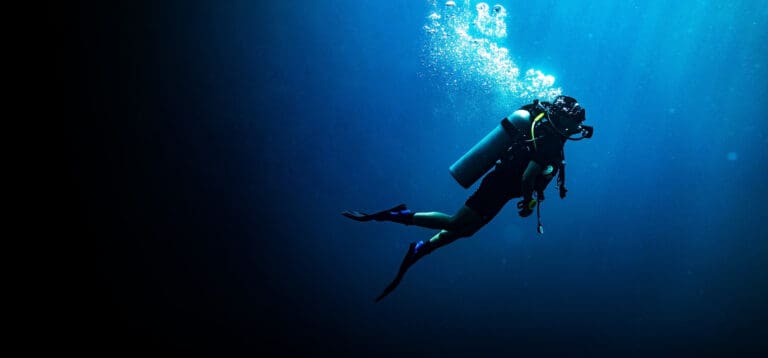
Researchers at the University of Minnesota Twin Cities, USA have developed an artificial intelligence (AI) system that enables autonomous underwater robots to monitor a diver’s breathing in real time by analysing their exhaled bubbles. The research represents the first time robotic vision has been used to estimate a diver’s human respiration rate underwater.
Monitoring a diver’s breathing is an important indicator of their physical condition, particularly in demanding underwater environments where stress, exhaustion or respiratory distress can quickly become dangerous. However, obtaining this information underwater has traditionally been difficult. Wearable sensors often struggle to function reliably beneath wetsuits and drysuits, while wireless communication through water is highly restricted.
The research team addressed this challenge by equipping autonomous underwater vehicles (AUVs) with cameras capable of tracking the frequency and volume of bubbles released from a diver’s regulator. By analysing these visual cues, the system can estimate breathing rate without requiring any physical contact with the diver.
To develop the AI model, researchers created a “fuzzy labeling” approach that combined thousands of manually labelled underwater images with synchronised audio recordings of regulator exhalations. This helped the AI learn to identify individual breaths, even in murky water where visibility is limited.
The team also collected extensive audio and visual data from a range of environments, including Lake Superior, Square Lake in Minnesota, and the Caribbean Sea off Barbados. Training across different water temperatures and visibility conditions helped improve the system’s ability to perform in varied underwater environments.
During field trials, the researchers demonstrated a communication system called HREyes, which classifies a diver’s breathing as below normal, normal or above normal based on breaths per minute. By identifying unusually high or low breathing rates, the robot can detect signs of potential stress and provide timely feedback to its human dive partner.
The researchers intend to expand the system by combining breathing-rate monitoring with analysis of diver movement. Together, these measures could provide a more comprehensive assessment of a diver’s wellbeing during underwater operations.
The study was published in The International Journal of Robotics Research.
Systems Engineering Perspective
This research demonstrates how systems engineering enables the integration of multiple technologies to solve a challenging real-world problem. Cameras, AI, autonomous underwater vehicles, audio processing and human-robot communication each contribute part of the solution, but only when they are designed to operate as an integrated system.
Developing dependable underwater safety systems requires careful consideration of operational environments, sensing limitations, communication constraints and human interaction. By bringing together these elements into a cohesive solution, systems engineering helps create technologies that improve safety, increase situational awareness and support more effective human-robot collaboration in demanding environments.
References
Clark, Gaby 2026, ‘AI underwater robots can now track diver stress via exhaled bubbles’, Tech Xplore, viewed 28 July 2026, <https://techxplore.com/news/2026-07-ai-underwater-robots-track-diver.html>
Pluchel, Kalie 2026, ‘AI underwater robots can now track diver stress via exhaled bubbles‘, College of Science and Engineering, viewed 28 July 2026, <https://cse.umn.edu/college/news/ai-underwater-robots-can-now-track-diver-stress-exhaled-bubbles>
2026, ‘AI underwater robots track scuba diver stress by watching exhaled bubbles’, Open Access Government, viewed 28 July 2026, <https://www.openaccessgovernment.org/ai-underwater-robots-track-scuba-diver-stress-by-watching-exhaled-bubbles/212531/>