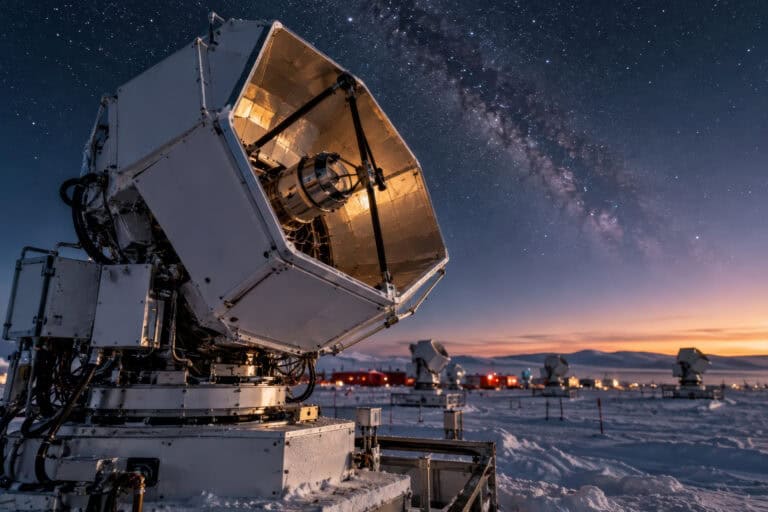
Illustrative image
Illustrative image (Credit: Sergio / Adobe Stock)
IceCube is a compelling Systems Engineering proof case.
IceCube – a scientific instrument buried deep beneath the Antarctic ice – has led to the 2026 Nobel Prize in Physics, highlighting an extraordinary combination of scientific vision, engineering and perseverance. Professor Francis Halzen of the University of Wisconsin–Madison, USA, has been awarded the prize “for decisive contributions to the IceCube Neutrino Observatory and the discovery of high-energy neutrinos of astrophysical origin.”
The idea behind IceCube dates back to Halzen’s proposal to use the Antarctic ice as a detection medium. Turning that idea into a functioning observatory, however, required an enormous engineering effort. Over seven seasons of construction, teams drilled 86 holes almost 2.5 kilometres into the ice and deployed thousands of optical sensors. The final sensor was installed on 18 December 2010, completing the detector. IceCube began its first fully-instrumented physics run in May 2011.
IceCube is a very unusual telescope.
Rather than using lenses like a conventional optical instrument, or listening to signals with radio dishes, IceCube converts approximately one cubic kilometre of exceptionally clear Antarctic ice into a particle detector. Buried between about 1,450 and 2,450 metres below the surface are 5,160 digital optical modules arranged along 86 vertical strings. Individual sensors detect tiny flashes of light produced when neutrinos interact with matter in the ice, advanced computational software integrates the individual results into “events” that are then reported for analysis.
The completed observatory is not simply a collection of sensors. It is a highly integrated system operating in one of the most remote and challenging environments on Earth. Once the optical modules are frozen into the ice, they cannot be physically accessed. Like spacecraft, inherent reliability and maintainability is essential since any subsequent problems must be diagnosed and corrected remotely.
The scale and ambition of the project make the engineering story almost as remarkable as the science.
IceCube achieved a very unusual project outcome.
The IceCube development and construction effort was completed on time, on budget, and has delivered spectacular technical performance. That was accomplished despite extreme logistical challenges, conduct outside traditional development environments, and despite a goal to operate well beyond technical state of the art.
A significant contributor was Randall (Randy) Iliff, Course Presenter and Principal Consultant with Project Performance International (PPI).
Randy served as the Systems Engineering Manager for the IceCube project, and was responsible for tailoring the systems engineering approach to the needs of an academically-driven scientific program. Randy subsequently documented his experience in IceCube as a Systems Engineering Case Study in the PPI SyEN news journal, edition 37. That paper examines how systems engineering was applied within a scientific environment and the lessons that could be drawn from the development of a “Discovery Class” research instrument. The paper also points out the critical need for SE to be closely integrated with project management effort.
In honor of the project recognition, we are sharing that article once more. Many years have passed, but the logic remains as sound as ever.
The paper is also incorporated into PPI’s Systems Engineering Management courseware, where it provides course participants with a real-world example of systems engineering being applied to an unconventional and highly complex development program.
Randy has devoted the last twenty years to advancing “non-traditional” applications of SE, and has worked as a PPI consultant with a number of organizations to help their leadership understand the market opportunity that SE represents. Randy has helped those organizations establish effective internal processes, refine workflows, and introduce useful knowledge management systems.
Systems Engineering Perspective
IceCube illustrates an important point about systems engineering: the discipline is not limited to conventional engineering products or industrial programs.
The project’s objective was fundamentally scientific — detecting elusive particles from distant astrophysical events — but achieving that objective required the coordinated development of many interacting elements: sensors, electronics, software, communications, data processing, infrastructure, deployment methods, operations and the people and organizations responsible for them.
The operating environment added another layer of complexity. Components had to be installed deep beneath Antarctic ice, at a location where physical access would become impossible after deployment. Decisions made during design and construction therefore had long-term consequences for operation, maintenance and scientific performance.
This is where systems engineering provides value. By looking beyond individual technical components and considering the system as a whole, engineers can establish the relationships between requirements, architecture, interfaces, verification, operation and the wider environment in which the system must perform.
IceCube demonstrates what can be achieved when this systems perspective is applied to a problem at the boundary of science and engineering. IceCube also demonstrates that the logic of SE holds enormous power even when the means of implementing SE might be considered “minimalist” by many in the field. It is the function of SE that matters most for outcome, the form of SE matters primarily for efficiency and sustainability reasons.
The 2026 Nobel Prize recognises the scientific achievement of Francis Halzen and the IceCube collaboration. It also provides a timely reminder of the engineering endeavour required to turn an extraordinary scientific idea into a working system.
IceCube is an extreme example, but the logic applied on that effort is universal.
There are systems everywhere that need direction and management to come into existence and deliver benefit to the world. Some of those systems need the full richness of modern SE methods and technology, some need merely to align with the logic of development more closely. Wherever along that continuum you fall, IceCube is a powerful example of what is possible when tasks and methods are properly aligned.
For PPI, the story has an additional significance: the systems engineering experience of Randy Iliff on IceCube continues to be shared with engineers and engineering leaders through our training and consulting work!
References
Nobel Prize 2026, ‘The Nobel Prize in Physics 2026’, NobelPrize.org, viewed 8 October 2026, <https://www.nobelprize.org/prizes/physics/2026/>
IceCube 2026, ‘Francis Halzen, IceCube principal investigator, wins 2026 Physics Nobel Prize’, IceCube Neutrino Observatory, viewed 8 October 2026, <https://icecube.wisc.edu/news/awards/2026/10/francis-halzen-icecube-principal-investigator-wins-2026-physics-nobel-prize/>
National Science Foundation 2026, ‘2026 Nobel Prize in physics awarded for NSF IceCube neutrino discoveries’, NSF, viewed 8 October 2026, <https://www.nsf.gov/mps/updates/2026-nobel-prize-physics-awarded-nsf-icecube-neutrino>
Nature 2026, ‘Nobel physics prize awarded for detection of cosmic neutrinos’, Nature, viewed 8 October 2026, <https://www.nature.com/articles/d41586-026-03092-1>
Iliff, Randall C. 2011, ‘IceCube as a Systems Engineering Case Study’, PPI SyEN, Project Performance International, viewed 8 October 2026, <https://www.ppi-int.com/systems-engineering-newsjournal/ppi-syen-37/>