Dear Colleague,
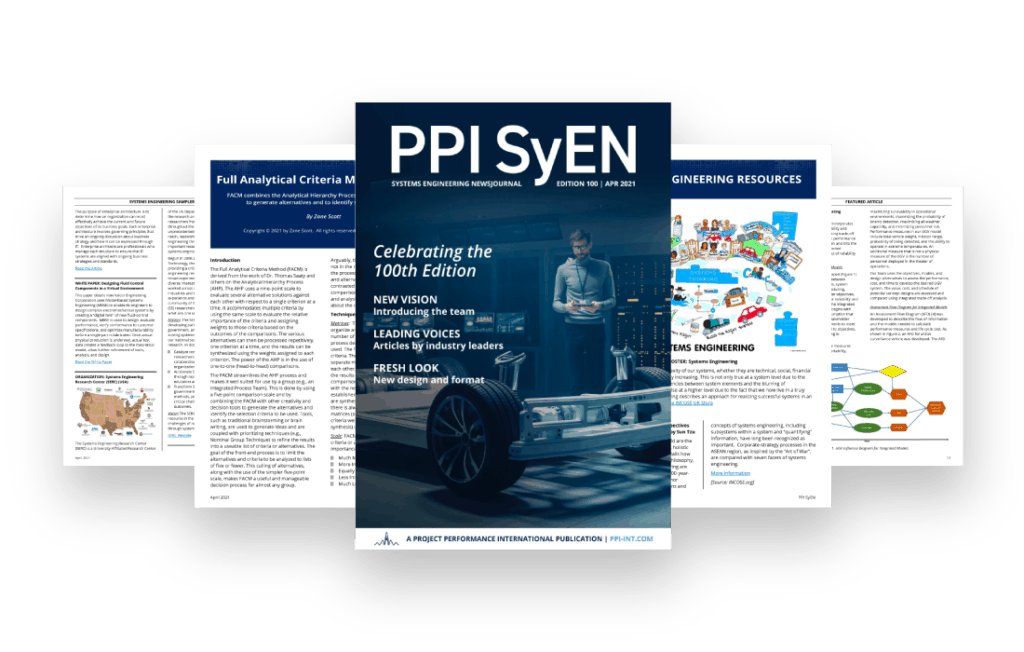
SyEN is an independent free newsletter containing informative reading for the technical project professional, with scores of news and other items summarizing developments in the field, including related industry, month by month. This newsletter and a newsletter archive are also available at www.ppi-int.com.
Systems engineering can be thought of as the problem-independent, and solution/technology-independent, principles and methods related to the successful engineering of systems, to meet stakeholder requirements and maximize value delivered to stakeholders in accordance with stakeholder values.
If you are presently receiving this newsletter from an associate, you may receive the newsletter directly in future by signing up for this free service of PPI, using the form at www.ppi-int.com. If you do not wish to receive future SE eNewsletters, please reply to this e-mail with "Remove" in the subject line, from the same email address. Your removal will be confirmed, by email.
We hope that you find this newsletter to be informative and useful. Please tell us what you think. Email to: contact@ppi-int.com.
A Quotation to Open On
Featured Articles
Systems Engineering News
Featured Society - International Test and Evaluation Association (ITEA)
INCOSE Technical Operations - Process Improvement Working Group
Systems Engineering Software Tools News
Systems Engineering Books, Reports, Articles and Papers
Conferences and Meetings
Education and Academia
Some Systems Engineering-Relevant Websites
Standards and Guides
Some Definitions to Close On - Earned Value Management (EVM) - Related Definitions
PPI News
PPI Events
"Engineering is a great profession. There is the fascination of watching a figment of the imagination emerge through the aid of science to a plan on paper. Then it moves to realisation in stone or metal or energy. Then it brings homes to men or women. Then it elevates the standard of living and adds to the comforts of life. This is the engineer's high privilege." - Herbert Clark Hoover, Engineer & President of the US from 1929-1932
Duarte Gonçalves
+27 12 841 3963
dgoncalv@csir.co.za
Council for Scientific and Industrial Research (CSIR)
P.O Box 395
Pretoria, South Africa
0001
Internationally, there appears to be a shortage of Systems Engineering (SE) skills as predicted by Professor Peter Lindsay of the University of Queensland (Australia)1: “The existing international shortage of systems engineers is likely to double in the next few years”. This is a problem, specifically in South Africa, where organizations such as the Council for Scientific and Industrial Research2 (CSIR), have a great demand for these skills. The Defence, Peace, Safety and Security (DPSS) unit of the CSIR provides defence science and technology support to the South African National Defence Force and various international customers. This unit has experienced growth of 30% in some business areas for a number of years leading to significant demand for SE skills.
The business value of screening to identify systems engineering potential lies in the cost currently incurred because of the shortage of SE’s and the lead-time in developing SE’s. These costs include opportunity costs resulting from not being able to access new projects, and project risks, a consequence of not having the adequate skills on current projects.
For systems engineers, an interview would identify whether the person has the requisite knowledge and skills. The situation is more complicated for candidate SE’s, however, as they would not yet have fully developed knowledge and skills. We can only look at candidate potential in terms of psychological attributes. These attributes include personality, cognition, values, interests, and attitudes. While some personality characteristics and cognitive abilities (Marais 200411, Toshima 199312, Kobori 199110, Capretz 20033 and Frank 20064) have been understood to be important for identifying systems engineering and related potential, values appear not to have received any attention. However, recent research (Gonçalves and Britz, 20096 and Goncalves and Britz, 20107) has identified values as potentially important in identifying systems engineering potential.
Comparing values, interests and attitudes, values are the most stable over time (George and Jones 1997): “work attitudes, as knowledge structures, should exhibit a certain degree of stability, but not as much stability as values because one of the functions of attitudes is to help the individual adjust to changing conditions over time and stay attuned to the social context”. In the remainder of this article the focus is on values.
A value system is defined as “…a generalized knowledge structure or framework about what is good or desirable which develops over time through an individual's involvement in the world. A value system guides behaviour by providing criteria that an individual can use to evaluate and define actions and events in the world surrounding him or her. An individual's personal set of values determines which types of actions and events are desirable or undesirable” (George and Jones, 19975).
For the assessment of values, the Value Orientations (VO), from Cognadev International13, was used. This model is drawn from Graves’ Spiral Dynamics Theory (amongst other theories). The VO measures seven broad value systems, which can be combined in a variety of ways to reveal the individual’s value orientation (the value systems accepted and rejected) and are represented in terms of different colours, in order to avoid ranking (Beck and Cowan, 20028). Each person may accept or reject different proportions of each of these value systems. The following value systems focus on individual needs:
The following value systems are more sacrificial and depict interdependent values:
A summary of correlations between the 21 systems engineering competencies on the INCOSE UK Competence Framework (INCOSE UK 20069) and the value systems found in the study (Gonçalves and Britz 20107) is presented below:
Competence |
Correlated with |
| Enterprise and Technology environment | not accepting Turquoise (We experience) |
| Determining and Managing Requirements | reject Green value system (We relate) |
| Concept Generation | accept Orange (I perform) but not Turquoise (We experience) |
| “Design for …” | not accepting Red (I control) while accepting Turquoise |
| Modelling and Simulation | not rejecting Yellow (I learn), Green (We relate) or Turquoise (We experience) and not accepting Red (I control) |
| Selecting the Preferred Solution | Yellow (I learn) accept and not rejecting Yellow |
| Integration and Verification | accepting Red |
| Enterprise Integration | not Red reject (I control), not Green Accept, not Turquoise accept |
| Integration of Specialities | Turquoise (We experience) reject |
| Lifecycle Process Definition | Red accept (I control) and Turquoise reject |
| Planning, Monitoring and Controlling | not rejecting Red (I control) and not accepting Turquoise |
Values, as assessed by the Value Orientations assessment contribute to predicting high competence on at least 11 SE competencies. It appears that values have not been considered in the literature on SE screening. For many of the SE competencies, it is about what value systems are not rejected rather than what is accepted. It is also clear that the values are different for different competencies. From these results it appears that a better strategy to addressing the shortage of systems engineers is not to look for the super-systems engineer, but to form a team of people that will bring various value systems (along with other characteristics) and SE competencies.
1 http://www.uq.edu.au/news/?article=4949
3 Capretz, Luiz Fernando. 2003. Personality types in software engineering. International Journal of Human-Computer Studies 58, (2): 207-214. Science Direct, via Elsevier Science Ltd, http://www.sciencedirect.com
4 Frank, Moti. 2006. Knowledge, abilities, cognitive characteristics and behavioural competences of engineers with high Capacity for Engineering Systems Thinking (CEST). Systems Engineering 9, (2): 91-103. Wiley Periodicals, via Wiley InterScience, http://www.interscience.wiley.com
5 George, M. and G.R. Jones. 1997. Experiencing Work: Values, Attitudes and Moods. Human Relations 50, (4): 393-414.
6 Gonçalves, D.P. and Britz, J. 2009. Screening Candidate Systems Engineers: A Research Design. Proceedings of the Nineteenth Annual International Symposium of INCOSE, Singapore.
7 Gonçalves, D.P. and J. Britz. 2010. Screening Candidate Systems Engineers: Exploratory results. To appear.
8 Beck, D.; Beck, D. & Cowan, C. (2002), Spiral Dynamics: Mastering Values, Leadership, and Change: Exploring the New Science of Memetics, Blackwell Publishing.
9 INCOSE, UK. 2006, Systems Engineering Core Competencies Framework, Technical report, INCOSE UK, Issue 2. Available from World Wide Web http://www. incose. org. uk/Downloads. Last accessed 06 March 2008.
10 Kobori, Yuzo. 1991. Development of a software engineer aptitude test. Quarterly Report of Railway Technical Research Institute, September, in Tokyo, Japan.
11 Marais, J. F. 2004. The Characteristics of a Great Systems Engineer. Proceedings of the Second Annual SA Chapter conference of the INCOSE, August 30 – September 1, South Africa.
12 Toshima, Yutaka. 1993. Standardization of an integrated aptitude test for system engineers: intellectual abilities and personality factors. Japanese psychological research 35: 182-92.
13 Cognadev International (2008), 'Value Orientations'. http://www.cognadev.com
Dr Alta de Waal
adewaal@csir.co.za
Meraka Institute
P.O Box 395
Pretoria, South Africa, 0001
Strategic decision support often involves the development of scenarios and complex strategy models. Many of the critical factors in the model may be non-quantifiable, since they contain strong socio-political dimensions. Furthermore, the uncertainties inheret in such problem complexes are in principle irreducible and often cannot be described fully. Associating quantitative measures to these uncertainties then becomes a superficial task.
The type of problems associated in the field of strategic decision support can often be described as wicked problems. The term 'wicked problem' was introduced by Rittel and Weber (1973) to describe complex problems that are mutlidimensional and nonquantifiable. The multidimensional aspect makes it difficult to solve one part of the problem without affecting another part of the problem. The nonquantitative aspect makes it difficult to solve with traditional quantitative methods (Plauché, 2010). Rittel and Weber defined wicked problems with the following characteristics (p. 161):
Nonquantified problem structuring methods addresses the shortcomings of traditional quantitative methods: Complex problem spaces such as wicked problems are approached by facilitating group interaction and providing a transparent framework for finding consensus on the problem definition.
Morphological Analysis (MA) is a problem structuring method that allows small groups of subject specialists to define, link and internally evaluate the parameters of complex problem spaces easily. This way, a solution space for the research question is created, as well as a flexible inference model.
A Bayesian network (BN) is not a nonquantified problem structuring method, but rather a probabilistic causal model. Therefore it allows for causal and hierarchical relationships between variables in the research question.
In De Waal & Ritchey (2007) we suggest the combination of these methods as two phases of a modelling process and thereby gaining the benefits of both methods when addressing wicked problems. A systems view of the problem is then obtained on two different levels:
We briefly discuss both methods and present a simple case study involving the use of both methods in sequence.
In a logical approach, as is the case with MA, the coexistence or consistency between each factor needs to be described. MA begins by identifying and defining the variables of the problem complex to be investigated. Then, each variable is assigned a range of possible values. For example, the variable 'colour' may have the values 'red', 'green', 'blue', etc. As a logical approach, the possibility of coexistence of all values between variables is investigated. It makes sense that a field with 8-10 variables, each having 4 or more values, have millions of possible configurations. The number of configurations is reduced by only allowing consistent configurations (see (De Waal & Ritchey, 2007) for a more detailed description).
The MA process goes through cycles of analysis and synthesis. These steps are (Ritchey and Stenström, 2002):
Analysis phase: Define the problem complex in terms of variables and variable values.
Synthesis phase: Link variables and synthesize an outcome space.
At any stage in the process, revisit particular steps to adjust variables, values, and consistency measures.
The focus of MA lies in its focus on problem formulation, parameterisation and the establishment of an internal structure. This is achieved in a systematic, traceable manner.
BNs are causal networks that establish causal relationships between variables. A causal network consists of nodes (variables) and arcs (directed links) between them. Each variable may have a range of (mutually exclusive) values. The strengths of the links between variables are defined by probabilities. The major modelling tasks can be captured by the following 3 questions:
Both MA and BNs allow the user to ask what-if questions. In practise this means that if a value of a variable is given as an input, the output (answer) of the model is the values of other variables that can be associated with the input. The difference between the two modelling methods is that MA answers the question with possibilities and BN answer the question with probabilities. This will become clear in the following case study.
The example that we present is a small model that involve the development of a decision support model for assessing the environmental impact of different fire-fighting methods under different conditions (see De Waal & Ritchey, 2007 for more detail). The objective of the model is to provide decision makers with the best fire-fighting method under different circumstances. The primary intension of the model is for planning, education and training.
The following figure illustrates the MA model for this problem complex. The columns represent the variables, with each cell depicting a possible value for the variable. This specific example can be interpreted as follows:
If the fire-fighting method 'water, no control' is used under the circumstances specified in the first four columns, it is consistent with the outcomes 'long and short term' environmental consequences.
The next step is to develop a causal structure of the variables defined in the MA field. The BN graphical structure for this is illustrated in the following figure.
Once the strength of the links between variables is established, the following 'what-if' questions can be asked: The first and most natural mode is synthetic and “predictive”, i.e. given a set of circumstances and a selected fire-fighting method, what is the likelihood of substances spreading, leading to negative consequence for the environment.
Another mode is analytic and ‘diagnostic’, i.e. given a degree of environmental impact, what are the circumstances and fire-fighting methods that can lead to this?
Morphological analysis and Bayesian networks were presented as two modelling methods in a two-phased modelling process. Both methods depict a problem complex in a systematic view. MA focuses on the logical relationships between variables and BNs depicts the causal relationships between variables.
Both methods enable the user to systematically evaluate decisions under different circumstances by asking what-if questions. Although the models cannot truly predict outcomes under circumstances, they aid the understanding of relationships between variables and how variables influence each other. These methods prove to be very valuable in decision support of wicked problems.
De Waal, A & Ritchey, T. Combining morphological analysis and Bayesian networks for strategic decision support, OriON, Volume 23(2), pp 105-121, 2007.
Plauché, M., De Waal, A., Grover, A., and Gumede, T. Morpological Analysis: A method for selecting ICT applications in South African government service delivery, Information Technologies and International Development, Volume 6(1), pp 1-20, 2010.
Ritchey, T., & Stenström, M. (2002). Using morphological analysis to evaluate preparedness for accidents involving hazardous materials. Study the Swedish Rescue Services Board presented at the 4th International Conference for Local Authorities, Shanghai. Retrieved July 2007, from http://www.swemorph.com/downloads.html
Rittel, H. W. J., & Webber, M. M. Dilemmas in a general theory of planning. Policy Science, Volume 4(2), pp 155–169., 1973
IIBA® announced the release of the new Business Analysis Competency Model, a tool for assessing the ability of business analysts to work in the role. It includes 53 competencies and indicators/behaviors of the competency, and describes the qualities that can make a Senior BA successful in performing the activities outlined in the BABOK® Guide.
The Competency Model is beneficial to organizations and business analysis professionals for a wide range of uses such as assessing performance, identifying areas for professional development, conducting job reviews, assessing training programs, and more. To learn about the Competency Model and Licenses, visit the IIBA website.
The INCOSE Working Group Award for Collaboration was presented to the Model Driven System Design WG (MDSD WG) Co-Chairs: Phil Spiby from Eurostep and Roger Burkhart from John Deere.
"For their professional contributions, personal efforts and over a decade of effort to bring ISO10303-AP233 to fruition as the enabler for information exchange in an integrated Model Based Systems Engineering environment."
Over the last year London Underground Ltd has been working on an architecture framework, TRAK. The original idea was very much centred on the rail domain. It is based on MODAF and in the process of distilling the bare bones we've ended up with something that is
March 16, 2010
INCOSE seeks to foster and accelerate doctoral research in the field of systems engineering, and one means to do this is by connecting graduate student researchers through a network. The purpose of SEANET is to advance systems engineering research by providing a collegial support network, research resources, and industry contacts that will enable the completion of doctoral dissertations related to systems engineering. The INCOSE SEANET invites current and soon-to-begin doctoral students to participate in a 1-day workshop at Stevens Institute of Technology in Hoboken, NJ. This event will precede the CSER 2010.
A new version of the INCOSE Systems Engineering Handbook is now available for download on INCOSE Connect in the Products Area. The primary purpose of the Version 3.2 update was to:
Version 3.1 of the INCOSE Systems Engineering Handbook remains the sole basis for the INCOSE CSEP/ASEP exam until further notice. An announcement will be made when Version 3.2 can also be used. For planning purposes, an exam update is currently scheduled for late April 2010, after which time both Version 3.1 and 3.2 may be used.
The International Test and Evaluation Association (ITEA), is a not-for-profit educational organization founded in 1980 to further the exchange of technical information in the field of test and evaluation. Its members include professionals from industry, government, and academia, who are involved in the development and application of policy and techniques used to assess the effectiveness, reliability, and safety of new and existing systems and products.
To be recognized as the premier professional association for the international Test and Evaluation community
To advance the field of Test and Evaluation worldwide in government, industry and academia
Email: membership@itea.org
Tel: 703-631-6220
Fax: 703-631-6221
More information: www.itea.org/
http://www.incose.org/practice/techactivities/wg/piwg/
The PIWG Charter is to:
The vision of the Process Improvement WG is to be the acknowledged leader in advancing the overall continual improvement of the Systems Engineering Processes throughout the systems engineering community.
The mission of the Process Improvement WG is to take stakeholders needs, real world constraints, and capture the direction for potential continual improvement for the systems engineering processes for the future. This captured direction should provide value added to systems engineering practitioners in the future.
The objectives of the Process Improvement WG are to:
2008 International Workshop SE Process Improvement Summary Presentation Size: 200K
Co-Chair: Karen Bausman, Air Force Center for Systems Engineering
Chair: Karen Richter
Contact SE Process Improvement and Capability Evaluation Working Group for additional information or to join this group.
Members of the Process Improvement WG meet twice yearly at the International Workshop and the International Symposium. They also hold teleconferences as needed and if an INCOSE Quick Review is required may interact through e-mail. There are several ways to participate including:
3SL announced the release of Cradle-6.2. Cradle-6.2 implements the first of many planned steps to ensure interoperability, supporting both current and up and coming data formats. The newly added support for XML and RIF 1.1a highlights this commitment. XML allows for consistent and predictable mapping of data between Cradle and other data sources, while RIF 1.1a builds on the XML functionality, extending Cradle data schema to match the Requirements Interchange Format heavily used in European auto manufacturing.
http://www.threesl.com/pages/webletter-March10/index.php
By Dominique Luzeaux and Jean-René Ruault
Publisher: Wiley, Publication Date: January 2010
ISBN-13: 9781848211643
Summary:
In recent decades, the systems designed in the fields of banking, health, transportation, space, aeronautics, defense, etc. have been becoming increasingly larger. With the growing maturity of information and communication technologies, systems have been interconnected within growing networks, yielding new services through the combination of the system functionalities. This has led to an increasing complexity that has to be managed in order to take advantage of these system integrations.
Part 1 “Systems of systems: concepts and practical illustrations” is a multidisciplinary work on the concept of the "systems of systems" that is discussed extensively in current literature. After a critical comparison of the different definitions and a range of various practical illustrations, it provides key answers as to what a system of systems is and how its complexity can be mastered.
Part 2 “Systems of systems engineering: methods and tools”’ focuses on both engineering and modeling, and standardization issues which are critical in order to deal with the key steps of systems-of-systems engineering: elicitation of stakeholders’ needs, architecture optimization, integration of constituent systems, qualification and utilization.
Volume: 3, Issue: 2 (December 2009)
PAPERS:
CASE STUDY:
The Systems Engineering Leading Indicators Guide editorial team is pleased to announce the release of Version 2.0. Version 2.0 supersedes Version 1.0, which was released in July 2007 and was the result of a project initiated by the Lean Advancement Initiative (LAI) at MIT in cooperation with:
Systems Engineering Leading Indicators Guide Version 2.0
15 - 17 March 2010, Washington, DC, United States
More information
15-19 March 2010, Oldenburg, Germany
More information
March 17-18, 2010, National Defense Industrial Association, 2111 Wilson Blvd, Suite 400, Arlington, VA 22201, USA
More information
17-19 March, Honoken, NJ, USA
More information
Satellite workshop of ETAPS 2010
March 21, 2010, Paphos, Cyprus
More information
21 - 26 March, 2010. Sierre, Switzerland.
More information
In conjunction with IEEE ECBS 2010, Oxford, UK
March 22-26, 2010
More information
22 - 26 March, 2010. Sierre, Switzerland.
More information
23 March, 2010. Laguna Cliffs Resort, Marriott Hotel - Dana Point, USA
More information
24th March 2010, University of Bristol, exact location MVB/KES, UK
More Information
April 5-8, 2010, Hyatt Regency Mission Bay Spa and Marina, San Diego, CA, USA
More information
April 7-8, 2010, Statler Hotel Amphitheater, USA
More information
April 7-9, 2010, Buena Vista Palace Hotel & Spa, Orlando, FL, USA
More information
Saturday, April 10, 2010 from 8:30 AM - 4:00 PM
West Lafayette, IN, USA
More information
April 10, 2010. Paris, France
More information
April 10, 2010, Atlanta, GA, USA
More information
April 10, 2010 from 8:30 AM - 4:00 PM (ET), West Lafayette, IN, USA
More information
10 – 15 April 2010, Atlanta, GA, USA
More information
Organised at CHI 2010
10 – 15 April 2010, Atlanta, GA, USA
More information
April 11 - 15, 2010, Florida Hotel and Conference Center; Orlando, FL, USA
More information
April 11 - 15, as part of the 2010 Spring Simulation Multiconference at the Florida Mall Hotel and Conference Center in Orlando, FL, USA
In conjunction with CPSWEEK 2010
April 12th, 2010, Stockholm, Sweden
More information
April 12-13, 2010 - Cuenca, Ecuador
More Information
12 - 15 April, 2010, Orlando, Florida, USA.
More information
April 13 - 15, 2010, USA
More information
April 13-15, 2010, Keele University, Staffordshire, UK
More information
15 - 18 April, 2010, Scottsdale, Arizona, USA.
More information
April 21, 2010, NDIA, Arlington, VA, USA
More information
April 21-23, 2010, Atlanta , USA
More information
23 to 25 April 2010, Bangkok, Thailand
More information
26-29 April 2010, Salt Palace Convention Center, Salt Lake City, Utah, USA
More information
April 30 – May 2, 2010, Adelphi University, Garden City, New York, USA
More information
32nd Int. Conf. on Software Engineering (ICSE 2010)
May 2-8, 2010, Cape Town, South Africa
More information
3 - 6 May, 2010, Stamford Grand, Adelaide, Australia
More information
(organized in conjunction with ISORC 2010)
May 4th, 2010, Carmona (close to Sevilla), Spain
More information
May 5-6, 2010, Carmona (close to Sevilla), Spain
More information
May 8th, 2010, Cape Town, South Africa
More information
May 17-18, 2010, Montreal, Quebec, Canada
More information
May 17-21, 2010, The Westin Lombard Yorktown Center, Chicago, Illinois, USA
More information
18-20 May 2010 - Pisa, Italy
More information
23 - 26 May, 2010, Stockholm, Sweden.
More information
Gaylord Opryland, Nashville, TN, USA
May 24 – Thursday May 27, 2010
More information
June 1, 2010,Trondheim, Norway
More information
June 7, 2010, Nantes, France
More information
In conjunction with CAiSE 2010
June 7-8, 2010, Hammamet, Tunisia
More information
In conjunction with CAiSE 2010
June 7-8, 2010, Hammamet, Tunisia
More information
In conjunction with CAiSE 2010
June 7-8, 2010, Hammamet, Tunisia
More information
In conjunction with CAiSE 2010
June 7-8, 2010, Hammamet, Tunisia
More information
07-11 June 2010, Hammamet, Tunisia
More information
June 8-11, 2010, George Mason University, Fairfax, Virginia, USA
More information
In conjunction with the 12th International Conference on Enterprise Information Systems (ICEIS 2010)
8 - 12 June, 2010, Funchal, Madeira - Portugal
More information
8 - 12 June, 2010, Funchal, Madeira - Portugal
More information
June 9-11, 2010, Singapore
More information
2nd Workshop in conjunction with SSIRI 2010
June 9-11, 2010, Singapore
More information
15/16 June 2010, Paris, France, in conjunction with ECMFA 2010
More information
June 15-18, 2010, Paris, France
More information
a satellite event of Petri Nets 2010
June 21, 2010, Braga, Portugal
More information
Colocated with ECOOP 2010
June 21 or 22, 2010 – Maribor, Slovenia
More information
21-25 June, 2010, Braga, Portugal
More information
Collocated with Petri Nets 2010
June 21-25, 2010, Braga, Portugal
More information
22 June 2010 to 24 June 2010, Henry Ford College, Loughborough University, UK
More information
June 23-25 2010 Prague, Czech Republic
More information
June 28 - 30, 2010, TEI of Larissa (Greece)
More information
In conjunction with Tools 2010 Federated Conferences.
June 30, 2010 - Malaga, Spain
More information
30 June – 2 July, 2010, Essen, Germany
More information
(in conjunction with CSBC 2010)
July 2010, Belo Horizonte, MG, Brazil
More information
Satellite workshop to TOOLS 2010, 1 - 2 July, 2010, Malaga.
More information
July 1-3, 2010, National Taipei University of Technology, Taipei, Taiwan
More information
July 5 - 9, 2010 in Vienna, Austria
More information
July 11–14, 2010, Ottawa, Canada
More information
July 12-15, 2010, Cambridge, United Kingdom
More information
11 - 15 July, 2010, Rosemont, IL, USA.
More information
In conjunction with COMPSAC 2010
Seoul, Korea, July 19 - 23, 2010
More information
July 21-23, 2010, Southampton, England, UK
http://iscepublishing.com/Forum/default.aspx?g=posts&m=227
More information
July 25 – 29, 2010, Seoul, Korea
More information
To be held in conjunction with ICIS 2010
August 18 – 20, 2010, Yamagata University, Yonezawa, Japan
More information
August 22-27, 2010 - Nice, France
More information
September 1st & 2nd, 2010, Valenciennes/France
More information
1-3 September 2010, Grenoble Institute of Technology, France
More information
September 13, 2010, Hoboken, New Jersey – USA
More information
September 15-17, 2010, Dresden, Germany
More information
September 15 - 18, 2010, Williamsburg, Virginia, USA at the College of William & Mary, Computer Science Department,
More information
Co-located with the International Scientific Colloquium (IWK2010)
September 16, 2010, Ilmenau, Germany
More information
September 20-21, 2010, Antwerp, Belgium
More information
21-24 September 2010, Singapore
More information
University Residential Center of Bertinoro, Italy
23-24 September 2010
More information
September 26-29, 2010, São Carlos - São Paulo - Brazil
More information
September 27-October 1, 2010, San Francisco
More information
Sep 27, 2010 - Oct 1, 2010, Sydney, Australia
More information
September 27-October 1, 2010, Budapest, Hungary
More information
September 27 – October 2, Leipzig, Germany
More information
27 September - 2 October, 2010. University Of Twente, Enschede, The Netherlands
More information
Joint with 2nd International Workshop on High Performance Computational Systems Biology (HiBi 2010)
September 30 - October 1, 2010, Twente, The Netherlands
Co-locating with
5th International Conference on Graph Transformation (ICGT 2010) , 29 September - 1 October, 2010
17th Annual workshop on Software Model Checking (SPIN 2010), 27 September - 29 September, 2010
More information
October 3-8, 2010, Oslo, Norway
More information
4 - 6 October, 2010. Keelung, Taiwan.
More information
October 4-6, 2010, The Westin Providence, Providence, Rhode Island, USA
More information
October 11 – 14, 2010, Nancy, France
More information
October 16 – 20, Reykjavik Iceland
More information
October 20 – 23, 2010, Lugano, Switzerland
More information
October 25-28, 2010, Hyatt Regency Mission Bay, San Diego, CA, USA
More information
October 26 – 28, 2010, Mϋnchen, Germany
More information
October 27-29, 2010, Paris, France
More Information
1-4 November 2010, Vancouver, BC, Canada
More information
Nov 7, 2010 - Nov 8, 2010. Taipei, Taiwan
More information
January 25-27, 2011, Dubai, United Arab Emirates
More information
The Systems Engineering Advancement Research Initiative (SEAri) at the Massachusetts Institute of Technology conducts collaborative research to advance the theories, methods, and effective practice of systems engineering applied to complex socio-technical systems. The group actively shares its research with the systems community through events and publications, and maintains a web-based repository with information, presentations, downloadable publications, and upcoming courses to provide timely access to ongoing and recently completed research. Current research sponsors include US government agencies, Singapore DSTA/DSO, MIT-Portugal Program, AF Human Systems Integration Office, and selected corporations.
The group’s research portfolio includes socio-technical decision making, designing for value robustness, systems engineering economics, and systems engineering in the enterprises. Targeted domains include defense, transportation, critical infrastructure, and energy. Research outcomes are prescriptive approaches developed through a combination of practice-based research and theory-based research. Highly collaborative efforts with project sponsors are designed to ensure research has impact on the real-world engineering organizations. The outcomes of research are also shared with the engineering community though an annual research summit, and through MIT’s Professional Short Course summer program. Evidence of the value of the work as perceived by the systems community is seen in recent recognitions including the 2009 Outstanding INCOSE Journal Paper, IEEE Systems Conference Best Paper Awards in 2008 and 2009, and the two INCOSE Best Paper Awards of 2008.
SEAri research is disseminated through various written forms, including publications, theses, presentations, and working papers.
Visit the SEAri website at http://seari.mit.edu or contact the leadership team at seari@mit.edu
Institution: University of Maryland, Baltimore County
Location: Baltimore, MD
Category: Faculty - Engineering - Other Engineering
Posted: 02/19/2010
Application Due: Open Until Filled
Type: Part-Time/Adjunct
UMBC is currently recruiting for part-time, adjunct faculty as they are expanding their professional master's, graduate certificate, special session and non-credit training programs.
Core areas of need include:
AWC and University of Arizona announced a partnership aimed to smooth the path to a bachelor of science in systems engineering that will be available starting in the fall of 2010.
MIT Engineering Systems Division
ESD has a mission to transform engineering education, research, and practice through the emerging field of engineering systems; and prepare engineers to think systemically, lead strategically, and address the complex challenges of today's world, for the benefit of humankind.
MIT Department of Aeronautics and Astronautics
MIT AeroAstro prepares engineers for success and leadership in the conception, design, implementation, and operation of aerospace and related engineering systems. We achieve this through our commitment to: educational excellence; creation, development, and application of technologies critical to aerospace vehicle and information engineering; and to the architecture and engineering of complex high-performance systems.
MIT Lean Advancement Initiative 
LAI is an evolving learning and research community that brings together key aerospace stakeholders from industry, government, and academia.
System Design and Management Program 
Created in 1996 in response to industry’s need to develop the next generation of leaders, SDM is at the forefront of graduate education at MIT. Not an MBA, SDM combines cutting-edge courses from the MIT Sloan School of Management and MIT’s School of Engineering, enriching the experience with innovative distance learning, flexible matriculation options and an interdisciplinary perspective.
Strategic Engineering is the process of architecting and designing complex systems and products in a way that deliberately accounts for future uncertainty and context in order to minimize the effects of lock-in while maximizing lifecycle value.
Humans and Automation Laboratory 
Research in the Humans and Automation Lab (HAL) focuses on the multifaceted interactions of human and computer decision-making in complex sociotechnical systems.
Council of Engineering Systems Universities
CESUN was established in 2004 by universities offering educational and research programs in engineering systems. Membership includes over 30 universities in North America, Europe, Asia, and Australia. The Council provides a mechanism for the member universities to work together developing engineering systems as a new field of study
SEANET Doctoral Student Research Network
SEANET is an INCOSE sponsored network of doctoral student researchers working in the field of systems engineering and architecting.
International Council on Systems Engineering
INCOSE is a not-for-profit membership organization founded in 1990 with a mission is to advance the state of the art and practice of systems engineering in industry, academia, and government by promoting interdisciplinary, scaleable approaches to produce technologically appropriate solutions that meet societal needs.
The IEEE Systems Council integrates activities of the Institute of Electrical and Electronics Engineers regarding aspects of multiple disciplines and specialty areas associated with the engineering of systems.
American Institute of Aeronautics and Astronautics
AIAA is the principal voice and technical society devoted to global leadership in the aerospace community.
USC Center for Systems and Software Engineering
CSSE is a research center at the University of Southern California aimed at evolving and unifying theories and practices of systems and software engineering.
23–28, May 2010, Niigata, Japan
Information Processing Society of Japan /Information Technology Standards Commission of Japan(IPSJ /ITSCJ)
IPSJ /ITSCJ
Organizer contact: Jacky Takahashi at: inq-sc7niigata@itscj.ipsj.or.jp
Toki Messe Niigata Convention Center
Address: 6-1, Bandai-jima, Niigata-city, 950-0078, Japan
Web: http://www.tokimesse.com/english/
The IEEE announced that it has reaffirmed five standards related to software and systems engineering.
They are:
The standards are all sponsored by the Systems & Software Engineering Committee of the IEEE Computer Society.
Earned value management (EVM) is a project management technique which aims to measuring project progress in an objective manner. EVM combines measurements of project scope accomplishment, schedule, and cost within a single, integrated measurement and reporting system. EVM can provide an early warning of project problems.
EVM can be implemented very efficiently for small projects by using a spread sheet. For larger projects, software support, typically provided by project management software packages, will be more appropriate.
Basic EVM measures:
Derived EVM measures: Actual:
Derived EVM Measures: Forecast
Note: these “at completion” derived measures used to forecast “at completion” outcomes are subject to a variety of issues.
PPI's Software Engineering - A Systems Approach 5-Day course has undergone a name change and is now named "Software Development Principles and Processes". The course outline and course content is unchanged the name change is to highlight the courses application.
More information on this course can be seen here: http://www.ppi-int.com/training/software-development-course.php
Upcoming locations include:
View 2010/2011 Systems Engineering Course Schedule
Upcoming locations include:
View 2010/2011 RA&SW Course Schedule
Upcoming locations include:
View 2010/2011 OCD/CONOPS Course Schedule
Upcoming locations include:
View 2010/2011 Software Engineering Course Schedule
Upcoming locations include:
View 2010/2011 Cognitive Systems Engineering Course Schedule
Kind regards from the SyEN team:
Robert Halligan, Managing Editor, email: rhalligan@ppi-int.com
Alwyn Smit, Editor, email: asmit@ppi-int.com
Luke Simpson, Production, email: lsimpson@ppi-int.com
Project Performance International
PO Box 2385, Ringwood, Vic 3134 Australia
Tel: +61 3 9876 7345
Fax: +61 3 9876 2664
Web: www.ppi-int.com
Email: contact@ppi-int.com
Tell us what you think of SyEN: email to contact@ppi-int.com
If you do not wish to receive a copy monthly of SyEN in future, please reply to this e-mail with "Remove" in the subject line. All removals are acknowledged; you may wish to contact us if acknowledgement is not received within 7 days.
COPYRIGHT 2010 PROJECT PERFORMANCE (AUSTRALIA) PTY LTD, ABN 33 055 311 941. May only be copied and distributed in full, and with this Copyright Notice intact.
SyEN makes informative reading for the project professional, containing scores of news and other items summarizing developments in the field of systems engineering and in directly related fields.