Home » Training » Design Training Courses » Architectural Design 3-Day
Architectural Design 3-Day
- 3 Days
- Corporate Delivery (In-person or online)
- Certificate upon completion
- Professional Development Credits
Get Started Today
Register your interest now.​
Let's Talk
Whether you have a question or are looking to find out more about our training options then please get in touch with us below. Â
- Summary
- Course Overview
- Course Outline
This three-day course addresses the principles and methods of designing, regardless of what is being designed. The course provides an integrated approach to the set of technical design process disciplines. These combine with technology knowledge to contribute to the satisfaction of requirements and optimization of system effectiveness, enhancing project success and reducing risk to the enterprise.
- This course may be credited toward the maintenance of the INCOSE Certified Systems Engineering Professional (CSEP) certification for 24 Professional Development Units and PDUs may be claimed for PMI’s family of certifications, including PMP
- This course qualifies for Engineers Australia and Engineering New Zealand (IPENZ) CPD purposes (24 hours)
- This course may qualify for CPD, CLP and similar purposes with other organizations (24 instructor hours)
- This course may be credited toward the maintenance of the Project Management Institute (PMI) certifications. Suggested PMI Talent Triangle® PDU allocation:
- Ways of Working – 18
- Power Skills – 5
- Business Acumen – 1
Let's Talk
Whether you have a question or are looking to find out more about our training options then please get in touch with us below. Â
Interested in corporate delivery? Click the ‘Let’s Talk’ button above and enquire today!
Key Learning Objectives
At the conclusion of this course, participants are expected to have learned:
- the overall concepts which are characteristic of a systems approach to design;
- the overall process elements, and their relationships, that collectively constitute the process building blocks of design (verb);
- learn a structured approach to physical design, use logical solution to help get physical design right, evaluate solution alternatives (conduct trade-off studies) and optimize design in a structured way;
- learn in overview about the disciplines of reliability engineering, safety engineering, maintainability engineering and producibility (manufacturability) engineering;
- how to tailor the application of design principles and methods to different application scenarios.
Training Method and Materials
The course makes extensive use of course workshops to put into practice the techniques covered in theory sessions. The training is delivered using a mixture of formal presentation, informal discussion, and extensive workshops that exercise key aspects of a systems approach to design, using a single system throughout. The result is a high degree of learning, as evidenced by workshop work products.
Participants are provided with:
- comprehensive course materials containing presentation material and supporting reading material
- a workbook containing workshop exercises, with worked examples
- numerous supplementary descriptions, checklists, forms and charts which you can put to use immediately
- complimentary access to PPI’s evolving Systems Engineering Goldmine
Some Key Questions
- What is architecture?
- Is architecture different to design?
- What is a systems approach to design and how is it relevant?
- What is the relevance of waterfall development, incremental development, evolutionary development, agile, spiral development, lean, simultaneous/concurrent engineering?
- What is the timing relationship between logical and physical design?
- What is logical design, and what forms can it take?
- Why do we care about logical design?
- What is model-based architecting? Model-based design? Are model-based and model-driven different?
- What is object-oriented design and how does it relate?
- What languages and tools are applicable for model-based work?
- Where does FMEA figure?
- Is FMECA different to FMEA?
- What about FTA and ETA, where do they figure?
- Are model-based techniques limited to certain technologies?
- How can we be sure we have come up with the best design?
- Everywhere I turn there seems to be uncertainty. How can I make design decisions in the presence of such uncertainty?
- Is there a reliable and efficient way to optimize design?
- What are the Skills, Knowledge and Attitudes (SKAs) conducive to success in being a designer?
Who Should Attend This Course?
This design course is designed for personnel who perform or manage the development of small to large technology- based systems, products, capabilities, etc. The course will be of particular value to people with job titles such as:
- System architect
- Enterprise architect
- Design engineer
- Systems engineer
- Business analyst
- Systems analyst
- Software systems engineer
- Software engineer
- Specialty engineer – reliability, safety, maintainability, producibility
- Hardware engineer
- Research engineer
- Project engineer
- Logistics Support Analysis Specialist
- Industrial engineer
- Other engineering job titles
- R and D manager
- Engineering manager.
0. Introduction – Architectural Design Within Systems Engineering
- The business case for a systems approach to design
- Definition of terms
- Design interactive exercise – basic
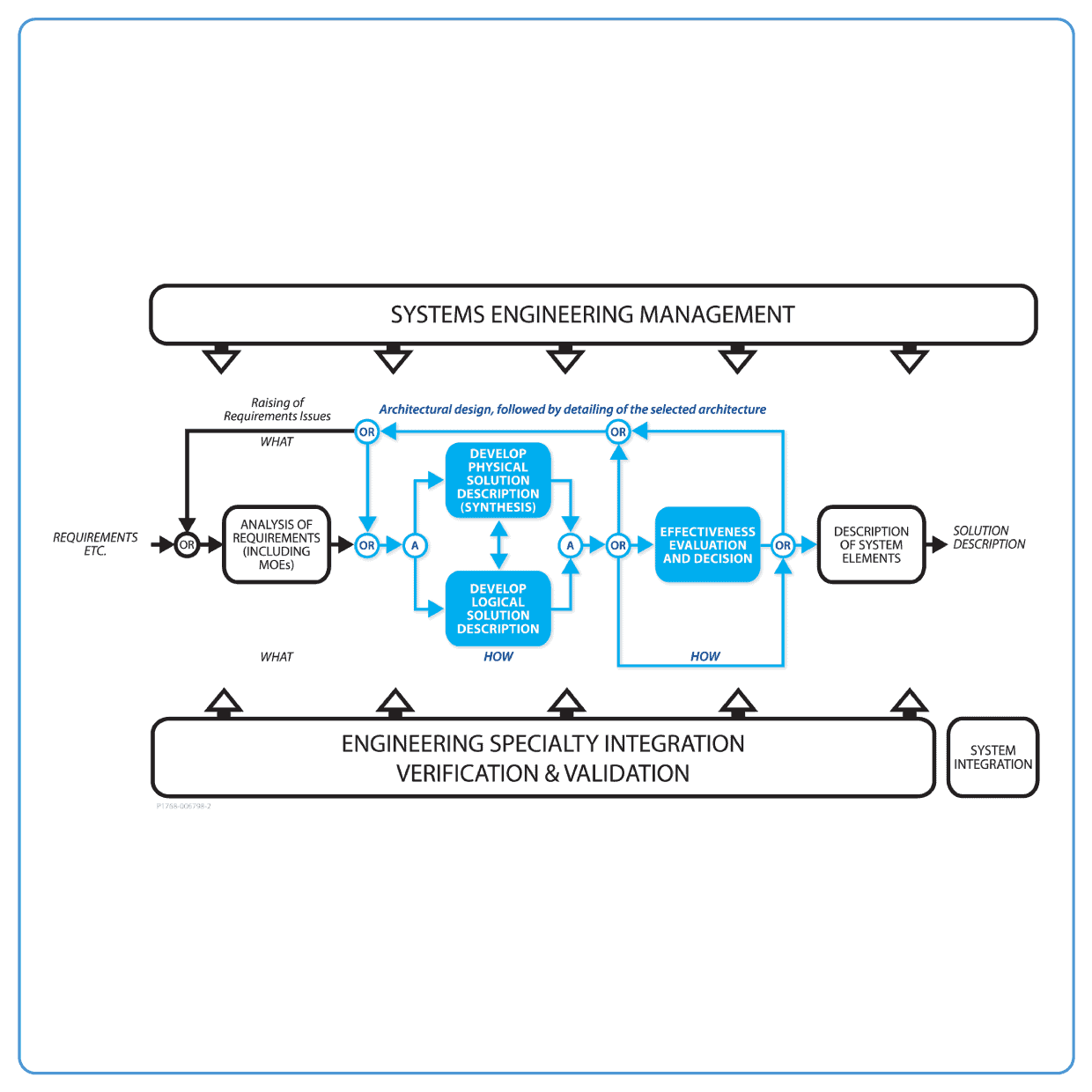
- Systems engineering process overview – the football diagram
- Design within a systems engineering process model
1. Design-Related Principles of Engineering
- System views
- Workshop 1 – design-related principles
2. System Development Strategies
- The solution domain: key concepts, relationships, and work products
- Waterfall, incremental, evolutionary, spiral and agile development approaches
- Workshop 2 – solution development strategies for a product
3. Concepts of Architecture and Detailed Design – Physical and Logical
- Physical architecture (structural view) – basic concepts
- Logical architecture – basic concepts
- Logical architecture related to physical architecture
- Useful forms of logical representation – functional, state-based, mathematical, hybrid, … with examples
- Model-based design in practice – MBSE/MBA/MBD/MDA/MDD
4. Initial Physical Conceptualization
- The role of technology and innovation
- Architectural design driver requirements
- Workshop 3 – identification of architectural design driver requirements
- Techniques for stimulating innovation: brainstorming, TRIZ
- Perspiration engineering: configuration items
- Criteria for selecting configuration items
- Design complexity trade-off
- Relationship of CI definition to system integration
- Interactive exercise – a simple physical design
- Workshop 4 – physical conceptualization of solution
- Reconstitution (Aggregation)
5. Functional Design
- Functional analysis in design – how to do it
- Functional analysis/architecture process
- Item flow and control flow
- Un-allocatable and allocatable functions
- Pitfalls in defining functions
- Common pitfalls in functional design
- Interactive exercise – a simple functional design
- Workshop 5 – physical and functional design, part A
- Workshop 5 – physical and functional design, part B (optional)
- Coupling, cohesion, connectivity
- Failure Modes and Effects Analysis (FMEA)/Failure Modes, Effects and Criticality Analysis (FMECA) in design
- Performance thread analysis
- Allocation of functionality between hardware and software
- Fault Tree Analysis
- Event Tree Analysis
- Behavior modeling languages
- Other languages incorporating functional modeling: SysML, …
- Software tools supporting functional and physical design
- Pitfalls in functional design
6. State-Based Design
- State-based design – how to do it
- Workshop 6 – a simple state-based design
- Relationship to object orientation
- SysML, and alternative languages incorporating state-based modeling
- Software tools supporting state-based design
- Pitfalls in state-based design
7. Object Process Methodology (OPM)
- Background to OPM
- OPM description
- Software tools supporting OPM
8. Design Decision-Making and Optimization – Trade-Off Studies
- Designing for feasibility
- Designing for effectiveness: approach to design optimization
- The role of MOEs and goals
- The origin of a system effectiveness model
- Designing for the company versus designing for the customer – handling common interest and conflict of interest
- Using a system effectiveness model
- Taking account of risk relating to goals
- Taking account of risk relating to satisfaction of requirements
- Event-based uncertainty
- Risk aversion
- Exercise – using a system effectiveness model
- Cost/capability, return on investment and like concepts
- Iterative optimization of design – a very effective methodology
- Other techniques – Quality Function Deployment
- Software tools supporting design decision-making
- Some common pitfalls in design decision-making
9. Design For Six-Sigma (DFSS)
- What is Six-Sigma?
- DMADV (DFSS)
10. Return to Physical Design
- Functional to physical allocation
- Facilities, procedures, people, and other types of system element
- System elements not designated as configuration items
- Some common pitfalls in developing system physical architecture
- Use of architectural design driver requirements
- Adding the detail to the design
- Design creates requirements – the duality of requirements and design
- Interface engineering
- Interface requirements specifications versus interface design descriptions/ICDs
- The OSI 7-Layer Model and similar communication protocol models in interface engineering
- Relationship to system integration
- Evolution of interfaces in systems having levels of structure
- Some common pitfalls in interface engineering
- Major artifacts created in design
11. Engineering Specialty Integration (ESI)
- What makes an engineering specialty special?
- Common engineering specialties
- A generic approach to ESI
- Organizational issues of ESI
- Pitfalls, and specialty engineering examples
12. Concurrent (Simultaneous) Engineering
- System of interest – enabling system relationships
- Why concurrent (simultaneous) engineering
- Organizational aspects of implementation
- Process aspects of implementation
- Pitfalls in implementation
13. Summary and Key Points
- Action plan
Featured Course Reviews
Great material and the knowledge of the presenter. The course provided very valuable information that will be put to use immediately.
Anthony
I learned a great deal about my co-workers by observing their reactions to the course material – an invaluable part of the course for me. I will also benefit from the templates and other example/reference material. Being able to use these tools or standard templates will also be highly beneficial.
Jane
Good structure in the course, supplemented by professional course material, presented by a presenter who knew what he was talking about.
Luke
Great material and the knowledge of the presenter. The course provided very valuable information that will be put to use immediately.
Kate