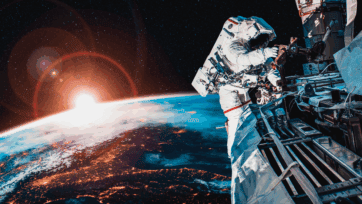

Illustrative image (Credit: dimazel / Adobe Stock)
A retired NASA research satellite re-entered Earth’s atmosphere in early March after more than a decade in orbit, marking the end of a mission that had once played a key role in studying Earth’s radiation belts. The spacecraft, part of NASA’s Van Allen Probes program, descended naturally as its orbit decayed, ultimately burning up during a controlled atmospheric re-entry over the Pacific Ocean.
Whilst most of the satellite disintegrated during descent, the event drew attention from space agencies and tracking organisations worldwide, highlighting the ongoing challenges associated with orbital debris, satellite lifecycles, and the safe management of debris returning from space.
What Happened
The spacecraft had originally been launched in 2012 as part of NASA’s Van Allen Probes mission, designed to investigate the charged particle environments surrounding Earth. After completing its primary scientific contribution and operating well beyond its intended lifespan, the satellite was eventually retired and left in a gradually decaying orbit.
Over time, atmospheric drag and solar activity slowly reduced the spacecraft’s altitude. By early March 2026, orbital tracking networks confirmed that the satellite’s path would lead to re-entry within days.
As the satellite descended into denser layers of the atmosphere, intense frictional heating caused the structure to break apart. Most components vaporised during the high-temperature descent, with any surviving fragments expected to fall harmlessly into remote ocean areas. Space agencies had previously assessed the risk to people or infrastructure on the ground as extremely low.
Consequences and Immediate Challenges
The re-entry did not result in reported injuries or damage, but it nevertheless illustrated the complexities involved in managing ageing spacecraft and the growing population of objects in Earth orbit.
Although the majority of satellites burn up during re-entry, engineers must carefully assess the possibility that certain parts, such as fuel tanks or dense structural components, may survive atmospheric descent. Monitoring networks therefore track returning spacecraft closely in order to refine predictions and provide accurate warnings if required.
The event also underscored the importance of international tracking systems. Agencies across multiple countries coordinate to monitor satellite trajectories, share orbital data, and estimate potential re-entry zones as objects descend from space.
Key Lessons Moving Forward & Systems Engineering Perspective
From a systems engineering perspective, satellite re-entry events highlight several important considerations for the design and management of space systems:
Lifecycle planning: Satellites should be subject to clear end-of-life strategies, including de-orbit capabilities or orbital transfer plans, to ensure safe disposal once missions conclude.
Orbital tracking integration: Robust global tracking networks are essential as system elements for monitoring space objects, predicting re-entry windows, and coordinating risk assessments across agencies.
Debris mitigation design: Engineers can reduce potential hazards by selecting materials and structural configurations that maximise burn-up during atmospheric re-entry.
International coordination: Shared standards and data exchange between national space agencies help improve transparency and reduce risks associated with re-entry.
Space sustainability frameworks: As commercial and government satellite launches accelerate, long-term policies and technical guidelines are increasingly necessary to manage orbital environments responsibly.
References:
Wall, Mike 2026, ‘Incoming 1,300-pound NASA satellite will crash to Earth on March 10’, Space.com , viewed 11 March 2026, <https://www.space.com/space-exploration/satellites/incoming-1-300-pound-nasa-satellite-will-crash-to-earth-on-march-10>
Mogensen, Jackie Flynn 2026, ‘NASA space probe expected to reenter the atmosphere with a chance of raining debris’, Scientific American, viewed 11 March 2026, <https://www.scientificamerican.com/article/nasa-space-probe-expected-to-re-enter-the-atmosphere-with-a-chance-of/>
TOI Science Desk 2026, ‘‘What if NASA’s 600-kilogram satellite crashes on Earth? Van Allen Probe fiery re-entry explained’, The Times of India, viewed 12 March 2026, <https://timesofindia.indiatimes.com/science/what-if-nasas-600-kilogram-satellite-crashes-on-earth-van-allen-probe-as-fiery-re-entry-explained/articleshow/129455613.cms>