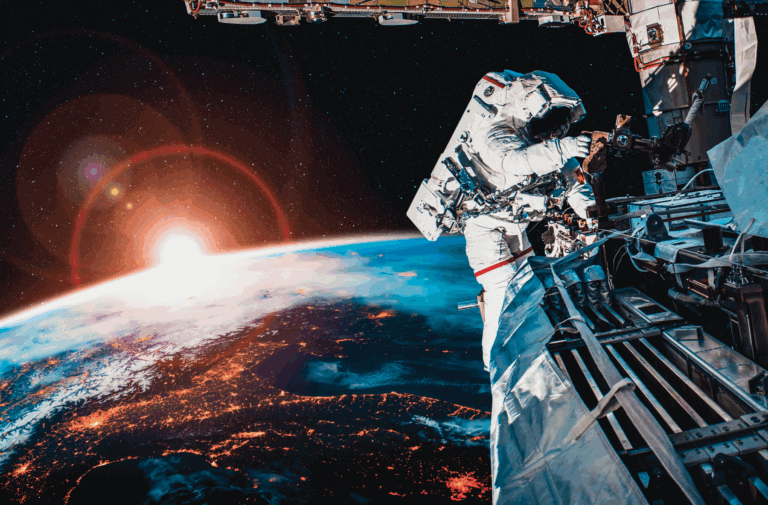
Illustrative image (Credit: InfiniteFlow / Adobe Stock)
Three Chinese astronauts remain aboard the Tiangong space station after their scheduled return to Earth was abruptly postponed in early November, following a suspected collision between their return capsule and a piece of orbital debris. The China Manned Space Engineering Office (CMSEO) confirmed that an impact-risk assessment was underway and that the return flight would be delayed “to ensure crew safety.” The crew mission commander Chen Dong and astronauts Chen Zhongrui and Wang Jie were due to complete the Shenzhou 20 mission after roughly six months in orbit.
Incident Overview
According to CMSEO and multiple news outlets, mission controllers detected signs of a possible debris impact shortly before the Shenzhou 20 crew’s scheduled undocking from Tiangong on 5 November 2025. The decision was made to postpone re-entry while engineers conducted structural checks and verified spacecraft integrity.
Reports from AP News and China Daily indicate that the astronauts remain in stable condition, continuing regular work and maintenance tasks on the station while awaiting an updated return schedule. A backup spacecraft, likely Shenzhou 22, is reportedly being prepared as a contingency option should the original return capsule be deemed unsafe.
Risk and Operational Consequences
While the crew are safe for now, the episode underscores the increasing hazards posed by orbital debris. Even a fragment the size of a bolt can travel at speeds exceeding 25,000 km/h, enough to puncture critical systems or compromise structural seals.
The delay disrupts China’s established six-month rotation cycle and could have ripple effects for the next launch sequence, consumables management, and Tiangong’s long-term occupancy schedule.
International observers have described the incident as a “near-miss scenario,” with analysts calling for greater investment in on-orbit inspection and rescue capabilities for human spaceflight programs.
Broader Context
China’s rapidly expanding space program, which has achieved a continuous human presence in orbit since 2021 and plans a lunar mission within the decade, faces growing scrutiny over risk management under operational complexity.
This event also arrives amid broader concerns about space debris proliferation, with the U.S. Space Command currently tracking over 30,000 sizable objects in low Earth orbit. The Shenzhou 20 delay highlights the limited real-time tracking coverage available for smaller fragments and reinforces the need for international coordination on debris mitigation and safe-return protocols.
Lessons and Emerging Priorities
The situation serves as a real-world test of crisis readiness in a high-stakes environment. Key priorities now emerging from analysts and mission engineers include:
- Debris monitoring integration: improving predictive collision-avoidance models through AI and cross-agency data sharing.
- Redundant return capability: maintaining a pre-positioned secondary vehicle or modular escape craft to mitigate single-point failures.
- Extended-mission resilience: ensuring life-support, psychological well-being, and consumable margins for unplanned extensions.
- Transparent communication channels: providing regular, factual updates to sustain public trust in human spaceflight operations.
A Systems Engineering Perspective
From a systems engineering standpoint, this incident reinforces the necessity of designing for predictable failure modes.
Space missions are socio-technical systems that operate under uncertainty and cannot rely solely on nominal performance assumptions. A robust system design anticipates and verifies resilience at multiple levels:
- System architecture: redundancy in re-entry, communication, and life-support subsystems.
- Failure detection and response: integrated telemetry loops capable of isolating and responding to structural anomalies.
- Lifecycle validation: continuous monitoring and iterative testing to ensure that debris-risk countermeasures meet defined safety thresholds.
- Human factors integration: mission planning that accounts for extended isolation, workload adaptation, and decision-making under stress.
Such considerations illustrate how systems engineering offers not just tools for managing complexity but frameworks for safeguarding human life in inherently uncertain operating environments, whether in orbit or on Earth.
References:
Associated Press 2025, ‘China’s stranded astronauts ‘in good condition’ after space debris delays planned return’, AP News, viewed 12 November 2025, <China’s stranded astronauts ‘in good condition’ after space debris delays planned return>
David, Leonard 2025, ‘Space rescue services needed? Two ‘stranded’ astronaut incidents are a ‘massive wake-up call,’ experts say’, Space.com: NASA, Space Exploration and Astronomy News, viewed 12 November 2025, <Space rescue services needed? 2 ‘stranded’ astronaut incidents are a ‘massive wake-up call,’ experts say>
Lei, Zhao 2025, ‘Shenzhou XX crew’s return trip delayed due to space debris risk’, China Daily, viewed 12 November 2025, <Shenzhou XX crew’s return trip delayed due to space debris risk>
People’s Daily Online 2025, ‘Astronauts’ return mission proceeds smoothly’, People’s Daily Online, viewed 12 November 2025, <Astronauts’ return mission proceeds smoothly – People’s Daily Online>